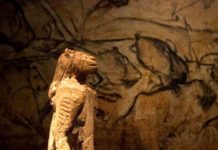
The Lion Man is a masterpiece. Sculpted with great originality, virtuosity and technical skill from mammoth ivory, this 40,000-year-old image is 31 centimetres tall. It has the head of a cave lion with a partly human body. He stands upright, perhaps on tiptoes, legs apart and arms to the sides of a slender, cat-like body with strong shoulders like the hips and thighs of a lion. His gaze, like his stance, is powerful and directed at the viewer. The details of his face show he is attentive, he is watching and he is listening. He is powerful, mysterious and from a world beyond ordinary nature. He is the oldest known representation of a being that does not exist in physical form but symbolises ideas about the supernatural.
Found in a cave in what is now southern Germany in 1939, the Lion Man makes sense as part of a story that might now be called a myth. It is impossible to know what that story was about or whether he was deity, an avatar to the spirit world.
Obviously, the story involved humans and animals. Lion Man is made from a mammoth tusk, the largest animal in the environment of that time and depicts the fiercest predator, a cave lion, now extinct, that was about 30 centimetres taller than a modern African lion and had no mane. Perhaps this hybrid helped people to come to terms with their place in nature on a deeper, religious level.
An experiment by Wulf Hein using the same sort of stone tools available in the Ice Age indicate that the Lion Man took more than 400 hours to make.
Stadel Cave faces north and does not get the sun. It is cold and the density of debris accumulated by human activities is much less than at other sites. This was not a good place to live. Lion Man was found in a dark inner chamber, carefully put away in the darkness with only a few perforated arctic fox teeth and a cache of reindeer antlers nearby. These characteristics suggest that Stadel Cave was only used occasionally as a place where people would come together around a fire to share a particular understanding of the world articulated through beliefs, symbolised in sculpture and acted out in rituals.
Lion Man is the oldest known evidence for religious beliefs and Stadel Cave suggests that believing and belonging have a deep history crucial to human societies and originating long before writing.
Удивительный малыш, по имени Кристиан Генрих Хейнике, появился на свет в 1721 году в городе Любек (Северная Германия) в простой семье. Его родители не были учеными: отец — художник и архитектор, мать — владелица магазина художественных изделий. Но именно у этих вполне обычных людей родился сын, который стал самым гениальным ребенком в истории человечества.
Уже в возрасте шести месяцев, когда дети едва издают звуки, маленький Кристиан умел повторять слова и даже разговаривать. К году мальчик уже мог выстраивать довольно сложные предложения, повторяя их за родителями и няней, которая занималась воспитанием необычного младенца. Именно гувернантка по имени Софи показывала младенцу изображения разных предметов и животных и требовала, чтобы он повторял их названия.
В год Кристиан научился читать и практически наизусть знал Библию, главную книгу того времени. А настольной книгой удивительного ребенка был труд Яна Амоса Каменского «Чувственная картина мира».
Малыш интересовался буквально всем и с легкостью усваивал информацию, обладая феноменальной памятью. Кристиан выучил четыре языка немецкий, латинский, французский и датский, обладал знаниями в области медицины, физики, истории, астрономии. Он читал наизусть религиозные псалмы и рассуждал о достоинствах различных сортов вина.
Когда мальчику исполнилось три года, он прочитал свою первую лекцию перед студентами и преподавателями любекской гимназии. Слушатели были поражены знаниями маленького вундеркинда, который начал свой рассказ с историй римских императоров, плавно перейдя к жизни библейских царей и закончил свое выступление лекцией о вопросах медицины.
Слава о гениальном ребенке дошла и до короля Дании Фредерика IV. Правитель отказывался поверить в уникальный дар мальчика и пригласил гениального ребенка продемонстрировать свои способности. Сказать, что Кристиан поразил короля, значит, не сказать ничего. Фредерик был поражен познаниями юного гения и дал ему прозвище Миракулюм («чудо-ребенок»). Надо отметить, что родители маленького вундеркинда вовсю эксплуатировали дар сына. К нему ежедневно приходило множество людей, с которыми ребенок разговаривал, как заправский профессор. Известные люди того времени восторгались гениальным малышом и с удовольствием беседовали с ним, как с равным.
Но при всем при этом все вокруг забывали, что Кристиан был всего лишь четырехлетним мальчиком, организм которого просто в какой-то момент не выдержал недетского напряжения. Надо отметить, что по настоянию гувернантки Софи ребенка кормили весьма однообразно. Малыш никогда не пробовал, например, мясо и рыбу, с самых ранних лет усвоив, что настоящий христианин не должен есть пищу животного происхождения. В меню Кристина в основном преобладали каши. Неправильный рацион спровоцировал болезнь желудка, Кристиану прописали диету, порекомендовав сбалансировать рацион малыша. Однако родители проигнорировали советы врачей и продолжили кормить ребенка кашами. О непереносимости некоторыми людьми глютена в то время, конечно, еще никто не знал.
Кристиана начали покидать силы, мучить головные боли и боли в суставах, пропал аппетит и началась бессонница. Но даже когда малыш пребывал в таком состоянии, к малышу продолжали пускать посетителей и он общался с ними. В середине июня 1725 года здоровье мальчика резко ухудшилось: тело и лицо ребенка покрылись страшными отеками, принимать пищу мальчик не мог совсем. 27 июня 1725 года стал последним днем жизни маленького гения.
Кристианн Генрих Хейникен умер в возрасте четырех с половиной лет. Но даже в своей смерти он остался философом. Когда врач перед его кончиной обрабатывал его отеки окуриванием из
целебных трав, малыш сказал: «Что наша жизнь — дым».
Прочитать на английском языке по гениального ребенка из Любека вы можете здесь.
On the sixth day of February, 1721, a sickly boy was born to a prominent painter in Lubeck, a small town in modern-day Germany. The boy was called Christian Heinrich Heinecken, also known as «the infant scholar of Lübeck».
At a very early age, Christian demonstrated astounding intelligence and psychic sophistication. According to the most whimsical reports, he was speaking within hours of his birth; according to others, the accomplishment took him a few months. It is, however, agreed upon that by the age of ten months Christian was asking informed questions, and that by the end of his first year, he was familiar with the Pentateuch. By his thirtieth month Christian had read all of the Catholic canon, and was an authority in the field of sacred history. By the end of his third year, he had not only managed to master both the ancient and modern histories available to him, but had also learned old-world geography, as well as to read in Latin and French. It was also in this year that the feeble boy stopped feeding at the breast.
By his fourth year, Christian was renowned regionally for his prodigious talent. He began to study the history of the Catholic Church, and to acquaint himself with its rituals. It was in this year that the King of Denmark requested his presence in Copenhagen, probably, most historians agree, to confirm the reports of the boy’s marvelous precocity. Christian was sent off to Copenhagen and returned after a few weeks without incident, but that he became sickly on his journey.
Soon after his return to Lubeck, Christian predicted his own death, which seemed to come in reaction to the prophecy. He died on the twenty-second of June, 1725, only four months into his fifth year.
In 1726, Christian’s mentor and tutor, a man know today only as Schoneich, published a book on the life of his student, called «The Life, Deeds, Travels and Death of the Child of Lubeck.» It was, of course, originally titled in German.
Modern experts now hypothesize by the nature of Christian’s study that what allowed him to accrue the knowledge he did was his incredible ability to assimilate complex information into his working knowledge base. They believe that his «intelligence» — his ability to learn — was in fact quite normal, but that his associative capacities were extraordinary, and allowed him to express what he learned and to make referential connections in ways unprecedented in his time. Nonetheless, comparable modern-day examples of Christian’s sort are estimated to have intelligence quotients well above 200 by standard testing.
You can read about the infant scholar from Lůbeck in Russian here.
1) С исчисляемыми существительными во множественном числе. —
Какие-то, некие, кое-какие, какие-либо, какие-нибудь, неопределенные, несколько. Переводится в зависимости от контекста.
I saw some creatures. Я увидел каких-то тварей. Я увидел несколько существ. Я видел кое-какие создания.
Some cars drove past me. Несколько авто проехали мимо меня. Какие-то машины проехали мимо меня.
2) С неисчислямыми существительными. Некоторое, неопределенное количество. Сколько-то. Сколько-нибудь. Ни много, ни мало, нельзя судить о количестве, но очень часто переводится на русский язык «немного», потому что по-другому в русском языке не говорят.
I need some time. Мне нужно время. Мне нужно немного времени (чаще всего в русском говорят так). На самом деле, сказано — мне нужно сколько-нибудь времени. ( Ни много, ни мало, неизвестно сколько).
She gave me some water. Она дала мне воды. Она дала мне немного воды (чаще всего мы переводим так). На самом деле, сказано — она дала мне некоторое количество воды.
3) С исчисляемыми существительными в единственном числе применяться не должно. Так как неопределенный артикль a\an означает: какой-то, какой-нибудь, какой-либо, некий, кое-какой.
Give a pen. Дайте мне какую-нибудь ручку.
Но в разговорном языке даже носители языка говорят: Give me some pen. Дайте мне какую-нибудь ручку.
С точки зрения литературного языка это неверно. На тестах и экзаменах это считается неправильным. Репетиторы и преподаватели исправляют на артикль a\an. Если задачи сдать экзамены не стоит, то это непринципиально. Но то, что это свойство разговорного языка на уровне «евойный», «тутова» и «нету» осознавать надо.
Any означает любой, любые, любое количество.
You can choose any toy. Ты можешь выбрать любую игрушку.
He could solve any tasks. Он мог решить любые задачи.
Any information will be appreciated. Любая информация будет полезна.
-) В отрицательных предложениях значение немного изменяется.
Some по-прежнему будет означать: какие-то, сколько-нибудь, несколько.
Any будет означать нисколько, никакие.
She hasn’t eaten some sweets. Она не съела некоторые конфеты. (А остальные съела).
She hasn’t eaten any sweets. Она не съела нисколько конфет. Она не съела никакие конфеты. ( Вообще, ни одной).
Также вместо any может использоваться no.
She has eaten no sweets. Она не съела никаких конфет. No является отрицанием, а поскольку в английском предложении должно быть только одно отрицание, то других отрицаний в пределах того же предложения быть не должно.
She hasn’t eaten no sweets — грубая ошибка из-за двойного отрицания.
?) В вопросительном предложении к some\any возможен двойной подход.
Упрощённый подход, которого в большинстве случаев достаточно:
some используется в вопросах с can, could, would like.
Would you like some tea?
Any используется в остальных вопросах.
Do you have any tea?
При этом, в вопросах some и any могут переводится одинаково. Сколько-нибудь. Какие-то. Какие-либо, какие-нибудь.
Развернутый подход: some используется, когда мы задаём вопрос об некотором количестве из всего. Any используется, когда мы спрашиваем обо всем количестве.
Do you still have some of the fish, I gave you yesterday? У тебя ещё осталась сколько-нибудь рыбы, которую я дал тебе вчера? Вопрос о некотором количестве.
Do you have any fish? У тебя есть рыба? (Вообще) Вопрос о всем количестве.
A long time ago — almost before history began — King Minos ruled the lovely island of Crete. The father of Minos was none other than Zeus, lord of all the gods, and he made sure that his son’s wealth and power only grew and grew.
Minos built a navy, and his ships sailed far and wide, bringing back goods, taxes, and something even more important than those; knowledge. For instance, when Minos wanted to build a palace that would strike awe and wonder into all who laid eyes on it, he asked his sea captain, «Of all the palaces you have seen, on all your travels over the seas, which was the most magnificent?» To which the sea captain replied, «Your Majesty, the King of Athens’ Palace of Aegeus surpasses all others for its beauty and grace. It was designed by Deadalus, and the Athenians boast that he is the most brilliant architect who has ever lived.»
When he heard this, King Minos ordered the sea captain to fetch Deadalus to Crete. The sea captain sailed to Athens and told King Aegeus that Minos had need of his chief architect and as Minos was the most powerful leader of those times, King Aegeus could not deny him his wish.
So Daedalus brought his knowledge and great skill to Crete and there he designed a wonderful palace for Minos. It was built on three floors, which was very high for buildings of those days, and the bathrooms and kitchens had plumbing that was far ahead of their times. Everywhere you went inside, you saw the double headed axe of King Minos which was his symbol of power. Upstairs, the walls were covered with bright pictures of dances and festivities. On them, you could see the young men and women of Crete leaping over the horns of bulls. It is a dangerous sport indeed, but the Cretans loved to show off their skill and bravery.
The happiness of Minos was almost complete – there was but one sadness in his life. His wife gave birth to a child that was strange and unnatural. Although its face was human, it walked on four feet with hooves. Horns came out of his head, and in time it grew into a terrible monster – half man, half bull. When it bellowed the whole land of Crete shook, the walls of the palace trembled, and there were storms at sea. The people gossiped about this strange child of the King, whom they called the Minotaur. Minos wanted to have it killed, but he thought the gods would be angry with him if he killed his own son. Instead, he ordered Daedalus to build a maze, known as a labyrinth, where the Minotaur could live out of sight and out of mind.
Daedalus built a Labyrinth underground that was so intricate and cunning in its design, that even he himself had trouble finding the way out.
The Minotaur agreed to live in the labyrinth, but he demanded human beings to be sent into his maze at regular intervals, otherwise he would rage with hunger, even until the walls of the palace fell down. And so Minos ordered the kings of the nearby lands to send ships full of young people to sacrifice to the Minotaur. Every ninth year it was the turn of Athens to send its human tribute to Crete. Twice, King Aegeus agreed to this – for he was still afraid of Minos and the power of his navy – but on the third occasion his son, Prince Theseus said to him, «Father, this time let me sail to Crete, and I shall kill the Minotaur and end this misery for our people.»
Aegeus was very reluctant to send his beloved son to chance his life against the Minotaur, but as he could see no other way out of the terrible situation for his people, he agreed.
It was decided that the ship of Theseus would carry two sets of sails. If the mission was successful, it would return to Athens under white sails, but if Theseus was killed by the Minotaur, it would sail back under black sails. That way, the people of Athens would receive the news of the outcome all the sooner.
Prince Theseus sailed to Crete and stayed with King Minos in his magnificent palace. There, on occasion, he caught sight of Princess Ariadne — the lovely daughter of King Minos. When Ariadne saw Theseus she felt great pity for him.
«Certainly, he looks very nice,» she thought, «But what a shame that his life is about to end so soon and so terribly! Even if he succeeds in killing the Minotaur, he will never find his way out of the dark and winding labyrinth.»
When Theseus saw Ariadne he thought, «Surely the King’s own daughter knows some of his secrets. If only she could be persuaded to help me, I might stand a better chance of killing the Minotaur and escaping from the labyrinth with my life.»
One day, when for a very short time Theseus found himself alone with Ariadne, he went down on his knees and begged her for any help that she could give him.
Ariadne promised to do what she could and that evening she asked the advice of Daedalus, for if anyone knew the way out of the maze, it would surely be its architect. Daedalus too wanted to help Theseus for they were both from the City of Athens, and so he gave Ariadne his secret plan of the labyrinth – but she was dismayed when she examined it and saw the numerous twists and turns in the underground passageways. Even with a map it would be impossible to find one’s way through such a maze.
Later on she found Theseus walking alone in the gardens and she gave him the map. When he unfurled the map and saw its complexity he said, «Oh Princess, I trust in my courage and my skill with my spear and my sword, but I doubt that I shall ever find my way out of a maze such as this.» However, Ariadne had thought of a second way to help Theseus; she gave him a ball of thread, and told him to unwind it as he went through the dark labyrinth. On the way back he should gather the wool up, and follow it back to the daylight.
Theseus was pleased with the plan, and he kissed the hand of the princess, thanking her for all her help. The next day he said to King Minos, «Your Majesty, I have been honoured to be your guest for one whole week. Now I am ready to complete my mission, and meet either death or glory.»
King Minos would have been happy for the foreign prince to rid him of the Minotaur, but he thought he stood little chance. He led Theseus to the entrance of the labyrinth and wished him goodbye — for he never expected to see him again. Theseus ventured into the maze, and a little way in he tied one end of the ball of thread to a beam. He went further and soon he was in complete darkness. He had to feel his way along the walls, and around the twists and turns of the labyrinth. All the while he unwound the ball of wool that Ariadne had given him. Somewhere deep inside, the bull was stamping and snorting, impatient to meet its latest sacrifice.
At last, deep within, Theseus could hear that the Minotaur was close by. He found a passageway that led to a dead end, as many of them did, but what made this one different was that there was a sudden turning just before the end. He had seen this passage on the map, and it was just the place he was looking for.
Theseus hid himself around this final twist and called out to the Minotaur. It heard him and came charging down the passage, but it could not slow down before the turning and charged straight into the wall. While it was still stunned from the impact Theseus thrust his spear into the beast’s neck and killed it, though it did not give up its life before letting out a terrible bellow.
The walls of the palace shook and trembled, and King Minos said, «Thank Zeus! It seems that Prince Theseus has rid us of the terrible monster — but he will never find his way out of the labyrinth and will surely die there.»
Theseus began to gather up the ball of thread until at last he reached the exit where Ariadne was eagerly waiting for him.
«Princess, how can I thank you?» said Theseus, «For without your help I would never have found my way out of that terrible place.»
Ariadne replied, «Take me back to Athens with you, and I shall be your bride.»
Now these were far from the words that Theseus had been hoping to hear. For although Ariadne was extremely beautiful, he was due to marry a different princess on his return to Athens. However, he could not quite find the words to explain this to Ariadne, and so he replied in haste, «Come, we must leave right away before your father discovers the truth.» Leading her by the hand, he led her down to his ship that was ready and waiting.
They set sail immediately for Athens, and in her heart Ariadne was overjoyed because she would soon marry her hero — or so she believed — but he had different plans. On the way back, they stopped at the island of Naxos to gather supplies. Ariadne walked to the end of the beach, paddling in the waves, and Theseus told the sea captain to set sail as fast as he could. Poor Ariadne was marooned on the island of Naxos abandoned by her faithless lover. She stood high up on the cliffs and watched his sail disappear over the horizon. As she shed bitter tears, Bacchus, the god of wine, heard her weeping and decided to cheer her up as best as he could. He led his procession to her; wild animals and dancing servants banging on drums and sounding trumpets. He took her crown from her head, and cast it up into the sky. It soared up to the heavens and its jewels turned into stars and formed a constellation in the shape of a crown.
As Theseus sailed away, he was laughing with the sea captain about the trick they had played. Poseidon, the god of the seas, heard them and was angry with Theseus for his betrayal of the princess — he sent a storm to toss his ship. The white sales were ripped and torn and fell into the raging seas. The ship survived the storm, but the captain was forced to repair his ship and use the second set of sails – the black ones which were meant to signal failure.
As they approached Athens, they were spotted by fishermen who raced back home to report the dreaded news.
The ship of Theseus, the hope of Athens, was returning under black sails. When this news reached the ears of the old king he ordered his chariot to take him down to the harbour to see the ship return. When he saw that it was indeed returning under black sails, he was filled with uncontrollable grief and threw himself from the top of the harbour tower and into the sea where he drowned.
And that is the story of how Theseus betrayed Ariadne who had helped him escape death in the labyrinth of the Minotaur. Bertie says that if you ever visit the National Gallery in London, you can see a famous picture of Ariadne and Bacchus on the island of Naxos – it’s by an Italian painter called Titian.
And that was not quite the end of the tale, because there is another story about what happened to Daedalus, the architect of the famous Labyrinth. Bertie says it’s a much shorter story, but it’s a good one — with a moral to it.
In the 1930s, an Indian girl named Shanti Devi claimed she was the reincarnation of another Indian woman named Lugdi Bai. Ludgi was born on January 18, 1902. She got married at ten and lost her first child after suffering a stillbirth. She birthed a second child on September 25, 1925, but died of pregnancy complications on October 4.
Shanti was born on December 11, 1926. She rarely talked as she grew older. When she did, it was about her husband and children. She said her husband, named Kedarnath, lived in Mathura, and they had a son. She described her husband, his shop, and his house. She also described the way she dressed when she was with him and the things she used to do.
Shanti’s family started taking her stories more seriously after she described how she died. The revelations startled a physician, since Shanti was too young to have understood the surgical procedures she talked about. Her family later arranged a meeting between her and Kedarnath’s cousin.
Shanti recognized her husband’s cousin. She also recognized Kedarnath when she finally met him, even though he was deliberately introduced to her as her former husband’s brother. The news of the reincarnation spread through India. Mahatma Gandhi even selected 15 people to investigate Shanti’s claims.
The team followed Shanti to Mathura, where she recognized several people, described how they had changed since her death, and led them to her husband’s house, even though she had never been there before. The news garnered worldwide attention after the team published their findings. Sture Lonnerstrand, a Swedish man who traveled to India to expose Shanti’s story as a hoax, concluded that it was true.
Born Catherine Muller, Helene Smith (1861–1929) was a famous late-19th century Swiss medium. She was known as «the Muse of Automatic Writing» by the Surrealists, who viewed Smith as evidence of the power of the surreal, and a symbol of surrealist knowledge.
She claimed to be reincarnated from the famous French queen Marie Antoinette. She also claimed to be the reincarnation of the daughter of an Arab sheikh and the wife of a Hindu prince. Helene Smith worked as a spiritual medium, claiming to receive messages from unseen creatures.
Smith frequently fell into trances, during which she claimed to communicate with Martians. She also said she understood the language spoken on Mars and would often speak and write what she purported to be Martian. She even made drawings of what the terrain of Mars looked like. Smith’s drawings of Mars showed beings, boats, houses, plants, bridges, and lakes scattered along the Martian terrain.
Hanan Monsour was born in the 30s in Lebanon. She married Farouk Monsour when she was only 20 years old and went on to have two daughters, Leila and Galareh. Soon after the birth of her second child, Hanan was diagnosed with heart disease and was warned to not have any more children. Despite this, she had a son in 1962. Her brother died in 1963 and soon after, Hanan started getting ill. She spoke a lot of dying and told her husband she would come back after death.
Hanan was 36 when she died after having heart surgery. She tried unsuccessfully to telephone her daughter, Leila, before the operation.
Suzanne Ghanem was born ten days after Hanan’s death. Her mother claimed to have had a dream, before Suzanne was born, in which a woman told her she was going ‘to come to her’. Much later, Suzanne’s mother saw a picture of Hanan Monsour and claimed it looked like the woman from her dream.
Suzanne was only 16 months old when she started tugging at the landline phone in her parent’s home and repeating the words: ‘Hello, Leila?” Her family was astonished by this as they did not know anyone called Leila. As Suzanne grew older, she told her parents that Leila was one of her children from a past life. At the age of two, she mentioned all three of Hanan’s children’s names as well as Farouk, her parents and brothers.Upon hearing this, the Monsours set off to visit Suzanne. While they were together, Suzanne identified all Hanan’s relatives and told Farouk that she remembered giving jewels to her brother Hercule before she had had her surgery. No one other than the Monsour family had known about this.
By the time she was five, Suzanne called Farouk multiple times a day. This continued until she was twenty-five years old. Farouk accepted that Suzanne was the reincarnation of Hanan and believed the physical resemblance between the two women was further proof.
Naturally, most believe this to be merely a coincidence or a hoax. But what truly transpired remains shrouded in mystery.
Anatoliy Golitsyn is a Soviet KGB defector and author of two books about the long-term deception strategy of the KGB leadership. During his time in the Soviet Union, Golitsyn worked in the strategic planning department of the KGB with the rank of Major. On December 15, 1961, under the name Ivan Klimov, Golitsyn defected with his wife and daughter to the Central Intelligence Agency (CIA) via Helsinki, Finland. Upon arrival he was interviewed by CIA counter-intelligence director James Jesus Angleton. Golitsyn provided information on many famous Soviet double agents including Kim Philby, Donald Duart Maclean, Guy Burgess and John Vassall. He claimed that Harold Wilson (then Prime Minister of the United Kingdom) was a KGB informer and agent of influence.
Golitsyn accused the KGB of killing British politician Hugh Gaitskell, so Harold Wilson could take over the Labour Party. Anatoliy Golitsyn successfully convinced CIA director James Angleton that the CIA had been infiltrated by numerous KGB agents. Golitsyn claimed that the KGB was using a campaign to learn how the CIA analyzed information, which was then used to manipulate America into helping the Soviet Union in its objectives. In response to this, James Angleton suspended the careers of multiple CIA officers who were under suspicion. Under most circumstances, the FBI and CIA did not support James Angleton or Anatoliy Galitsyn. In a notable account, Anatoliy Golitsyn suggested that the Sino-Soviet split was a deception plan to push America into the Vietnam War.
James Angleton went so far as to speculate that U.S. Secretary of State Henry Kissinger might be under KGB influence. In response to Angleton’s actions, a man named William Colby was put in charge of reorganizing the CIA. He officially relinquished the influence of Angleton and Galitsyn. James Angleton accused numerous foreign leaders of being Soviet spies. This includes Canadian Prime Ministers Lester Pearson and Pierre Trudeau, Swedish Prime Minister Olof Palme, West German Chancellor Willy Brandt, UK Prime Minister Harold Wilson and members of the United States Congress. James Angleton’s resignation was announced on Christmas Eve of 1975.
In 1984, Anatoliy Golitsyn published a book titled New Lies for Old. The text describes a series of predictions about the future of world governments. In the text, Golitsyn predicts the collapse of the communist bloc. He warns about a long-term deception strategy designed to lull the West into a false sense of security, with the result being an economic crippling and diplomatic isolation of the United States. The book claims that “as early as 1959, the KGB was working up a plot to manipulate foreign public opinion on a global scale.” In an interesting twist, a large collection of the predictions made in Anatoliy Golitsyn’s book have become historically accurate.
Present Simple в случае he, she, it также означает регулярное действие в настоящем или факт действия.
Образуется добавлением окончания -s(es) к инфинитиву по правилу множественного числа.
+) He like+S coffee. — He likes coffee. — Он любит кофе. Likes произносится глухо [s], потому, что слово like заканчивается на глухой согласный звук [k].
She read+S books. — She reads books. — Оначитает книги. Reads произносится звонко [z], потому, что слово read заканчивается на звонкий согласный звук [d].
The crazy bird warch + es me. The crazy bird watches me. Watches произносится [ız], потому, что слово watch заканчивается на шипящий согласный звук [tſ].
Произносится по правилам множественного числа!
Исключения:
Have [hæv]- has [hæz]. He has a car. — У него есть машина.
Do [duː] — does [dʌz]. She does sports. — Она занимается спортом.
Go [gəʊ] — goes [ɡəʊz] . He goes to the gym. — Он ходит в спортзал.
Say [seɪ] — says [sez] . Обратите внимание: произносится СЭЗЗ, а не СЕЙЗ. She says. — Она говорит.
-) Отрицание образуется при помощи does not, сокращённо doesn’t. Глагол имеет форму инфинитива без —s(es), исключения НЕ используются.
He doesn’t like cheese. — Он не любит сыр. После like нет окончания —s.
She doesn’t have a bicycle. — У нее нет велосипеда. После doesn’t уже не исключение has, а инфинитив have.
?) Вопросительная форма образуется выносом does на первое место перед подлежащим. ( Что такое подлежащее вы можете узнать здесь).
Глагол в вопросе будет инфинитивом. Без окончания —s(es) и без исключений.
Does it work well? — Это работает хорошо? Без окончания у глагола.
Where does she live? — Где она живёт? Без окончания у глагола.
What car does he have? — Какая у него машина? Используется инфинитив, не исключение.
Практиковать это правило лучше всего при помощи написания и пересказа коротких рассказов о человеке (друге, подруге, родственнике, знакомом, вымышленном персонаже) в настоящем времени размером в 12-15 предложений, также с аудиокнигами нулевого уровня: